They’ve even got a sequel out…
Writing
Pixar’s 22 Rules to Phenomenal Storytelling
I Love a Good Apocalypse: Three Movies so Bad, They’re Good
There’s something about low-budget dystopian sci-fi from the eighties and nineties…I don’t know if I can explain it. It’s just so…exuberantly bad. No computer graphics, no fancy set design, just a bunch of weirdos who somehow got access to a budget, and went running amok in the desert with a few old cars and gallons of fake blood. Horrible, yet innovative practical effects. Props made from spray-painted thrift store finds. Terrible dialogue. Worse acting. Bitchin’ synthesizer soundtracks. I love ’em. I’m not sure what that says about me, but there it is.
 Now I’m not saying these movies are good. They didn’t get robbed of an Oscar or anything. They ain’t Children of Men. If you’ll care to look to your right, you’ll see Matt Kincade’s Circle of Cheese™, illustrating that movie quality is in fact more circular than linear. If it gets bad enough, it gets good again. Crazy, counter-intuitive, but true. Because I said it’s true. And I think I know what I’m talking about.
Buckaroo Banzai, Mad Max, Escape from New York, some of these are pretty well known. But there are a few gems that seem to have slipped through the cracks.
These are a few of my favorite video-store finds, from back in the days before Netflix, when your parents wouldn’t pay extra for cable so you had four channels to choose from, and KTVU played The Road Warrior or Robocop like every other week which was cool, but still… if you wanted to see something different, you had to go on down to Blockbuster. And honestly, for being usurious corporate robots, they still had some pretty weird, obscure stuff.
Most of these you can find on the internet, whether on Netflix, for free on YouTube, or off the pirate bay. I don’t know, google it. Most of these are more fun if you’re slightly inebriated on your intoxicant of choice. Continue reading
Six Word Fiction Day

Inspired by a few other bloggers, also too lazy to write a full blog post today, I’m gonna try out this whole six word fiction thing. Here goes nothin’…
***
Then the world exploded. The end.
***
“Shouldn’t have left the baby there…”
***
“My love is the sea. And heroin.”
Author’s note: Oops, this is seven words. Let me try that again.
“My lover is the sea. Lion.”
***
“Cut the red wire, right?” Boom.
***
The applause turned to horrified screams.
***
He spread his wings and died.
***
“Oh my God he ate it.”
***
“You’re bluffing.”
“Afraid not.”
“Well, shit.”
***
“I wasn’t completely honest with you…”
***
“But flipping off cops is legal!”
I hate engines-a rant

Warning: The following is a bitter, rambling, disjointed rant. I really can’t suggest that you read it.
I hate engines. I hate ’em. They’re loud, obnoxious, cantankerous, smelly, foul, smoke belching little assholes. They eat fossilized hydrocarbons and they spit out greenhouse gasses and carcinogenic particulate matter. They’re literally killing us. I look forward to the near future, when we’ve switched over to electric cars, and the thought of a gasoline powered car is looked at with mild disgust and horror. How did people ever live like that? our children will say, as they step out of their self-driving electric car to go to the museum of motor vehicles, where they’ll probably stand inside some kind of special pollution chamber in order to smell what the early twenty-first century smelled like.
All of this occurred to me as I was trying to drink a cup of coffee and read a book (a trashy paperback) at a table outside a coffee shop. A shop that was right next to a minor side street. There I was, trying to settle into my book, when a diesel truck drove by, brrrrruuuuuummmmmmmm….. kachunk! clank! kch-bruuuuuuuuummmmmm…. spitting out a great, filthy cloud of black smoke as it went. I looked around, as this cancer cloud wafted over me, and saw that I was apparently the only one bothered by this. We’ve become so used to this that we don’t even notice how awful it is.
And then, a Tesla drove by. Absolutely silent. Zero emissions. I breathed a sigh of relief, knowing that this is the future. Soon, the internal combustion engine will be a barbaric relic of the past, and we’ll wonder how we ever put up with it.
Another thing I hate about engines: They break. They break a lot. It’s amazing they don’t break more often. It’s basically a little bomb going off six times per second inside of a little tube, and the explosion lifts a piston that powers your car. That, in and of itself, is pretty simple. But then everything else about an engine, probably two thirds of the mechanisms in the engine compartment, are simply designed to prevent the engine from ripping itself apart, which is what it really wants to do.
It’s a giant, insanely complicated Rube-Goldberg contraption to manage the craziness going on, from the split-second choreography of valves and cams that prevent the cylinder from turning into a pipe-bomb, to the coolant system constantly shunting away excess heat to prevent the whole mess from melting down, to the lubrication system that keeps it all from fusing solid…and then it’s all strapped to a big tank full of the explosive liquid it needs in order to live…well, you get the point. The point is, I hate engines.
Now let’s compare this insanely complicated contraption (an amazing feat of engineering, don’t get me wrong) to an electric motor. Even the most simple gas engine is a miniaturized version of the above-mentioned shit-show. A chainsaw, for example. It’s a bitch to start. It needs coaxing and tweaking and constant maintenance. It’s loud and cranky and smelly. It breaks down a lot. And then let’s look at, say, an electric blender. When was the last time you had to change the oil on your blender, or adjust the valve clearance or change your spark plug wires? How many moving parts does a blender motor have? One. There’s a stator (it’s static) and a rotor. (it rotates.) That’s about it. I’ve had the same blender for ten years. I bought it at a thrift shop, and it’s never given me any trouble at all.
This is really what excites me most about the prospect of an electric car. I mean, sure, saving the planet is cool. Paying a fraction of what gas costs to charge your battery is pretty sweet. But I’m mostly excited about cars that are simpler, quieter, and cleaner. Granted, a Tesla is a bit more complicated than a blender, but still.
With an electric engine you don’t need a coolant system. You don’t need a lubrication system. You don’t need a transmission or an exhaust system or a catalytic converter or a muffler. You don’t need to rattle the fillings out of somebody’s damned head with your engine braking and choke them with your fumes while they’re trying to enjoy a nice goddamned cup of coffee al fresco. An electric car, more or less, is just a big battery hooked to a big electric motor. Just a bunch of electrons silently shuffling around.
Of course, what would excite me even more is not needing a car at all. I love the freedom, I do. It’s great being able to go wherever, whenever, in my private motor-driven coach. It’s the god-damned American Dream. But I hate, I bitterly resent the fact that I need one.
In most places in America, it’s almost impossible to live without a car. And that sucks. Cars are ridiculously expensive. The maintenance is a pain in the ass. Insurance is a drag. They’re dangerous. They get stolen. They crash. They break at the worst possible time. And yet, living as I do in a country designed for cars, with pedestrians as a distant afterthought, in most places they are an absolute necessity of life. They’re such an absolute given, that most people never even consider that there might be a better way. I swear to god, it’s like we’re all in abusive relationships with our cars.
Growing up in a rural area, (where it was a thirty minute drive to the nearest grocery store) I’ve always had a bit of a city-phobia. It hasn’t been until very recently that I’ve spent enough time in a real city to appreciate the advantages (besides the advantage of actually having something to do). Being able to walk places. Available, affordable public transportation. Sidewalks. Taxi cabs. The possibility of being able to do without a car entirely.
Someday, that will be the case everywhere in America. Someday we’ll have actual public transportation. Someday we’ll stop designing new cities like cars are the primary residents. Someday our passenger rail system won’t be an overpriced joke. Someday we’ll be able to use our smartphones to summon a self-driving Uber to take us where we want to go. Someday there will be no reason to spend six months pay on a giant, overcomplicated money-pit of a contraption just so we can haul our groceries home.
But until then, oops, I’m about due for a new set of tires.
What’s wrong with pulp? Nothing, that’s what.

The Brothers Karamazov broke me. It straight-up broke my will.
Before that point, in my early community college days, I fancied myself as a young literati in the making. This was years before I ever had the courage to put pen to paper and transfer stories from my brain to a physical medium, but I still had this vision of myself as a man of letters, a cultured, educated person, with a deep understanding of Shakespeare, able to quote Montaigne or Kafka, sitting in some corner cafe and sipping a cappuccino while I read Sartre. Then that artsy girl sitting over by the wall would notice me, dammit!
This is why I thought I needed to read The Brothers Karamazov. I mean, I was smart. I was a reader. I’d gotten through the unabridged Hunchback of Notre Dame. I’d read Celine and Conrad and Heller and Huxley. I gritted my teeth and finished Dostoevesky’s other much-celebrated wall of text, Crime and Punishment. Surely, I would enjoy this famous, well-known, important book, right? Wrong. Good god. I gave it a try, I really did. But I’ve read more engaging soil-science textbooks.
The funny thing is, as a writer, I never wanted to be great. I’d like to be good, sure. I’d like to be entertaining. But it’s never been my goal to be profound or brilliant. Tough talking detectives. Dangerous dames. Vampires, zombies, spaceships. Dinosaurs. Vampires fighting zombie dinosaurs in spaceships. My inner world has always been sleazy and pulpy. Adventure and escapism was what sparked my love for reading in the first place. So why, now, was I turning my back on my first love for this stodgy old bitch of a novel?
And that’s the thing I realized, sitting on that bench outside the library at the community college, as I slogged through page after page of Fyodor Dostoevski’s seminal doorstop. I realized, I’m not enjoying this at all. I realized I wasn’t doing it because I liked it. I wasn’t doing it because I was gaining knowledge or insight or context or appreciation of the world. I was doing it to feed my ego. So I could be that smart guy. So I could look down on the uneducated rabble and laugh snootily. “What’s that you’re reading, Stephen King? Oh my word, how very jejune…”
That same day, I dropped The Brothers Karamazov, with a weighty thump, into the library’s book return. And I checked out a dog-eared paperback copy of Stephen King’s The Stand.
Since then, my primary judgement of “good book” or “bad book” are the simple questions: Do I give a shit? Do I care what happens next? Do I want to turn the page?
Now I’m not saying that there isn’t great literature out there to be had. Steinbeck and Hemingway were both writers who will practically bash you over the head with their brilliance, yet their stories are entirely readable. I want to turn that page. And even popular authors have gems of wisdom and insight hidden within their pulpy adventure stories. It’s like they can’t help it. The greatness just oozes out, somehow. Nelson DeMille is a perfect example. His bread and butter is writing airport-bookstore paperbacks about terrorists blowing up New York or whatever, and yet if you read The Gold Coast or Up Country, you’ll see soul-baring storytelling that approaches brilliance. The same with Philip K. Dick. It’s like he was trying to write pulp sci-fi, but somehow wound up with philosophy. Dashiell Hammet and Raymond Chandler, in their day, were considered cheap trash writers. And now they’re classics.
Now, don’t let me stop you from trying out Dostoevski. He is still in print after 150 years, and I guess that has to mean something. Just because it wasn’t for me, doesn’t mean it won’t be for you. The point is, you don’t owe a book a damned thing. If you don’t feel like it’s grabbing you, if you don’t give a shit and you have no desire to turn the page, kick it to the curb and go find something you do like. Even if I wrote it. Even if you’d be embarrassed if that artsy girl in the cafe saw you reading it.
The Funny Thing About Idols
Sometimes you build up a picture in your head, and then reality doesn’t quite match up. Most of the time, in fact.
I play a little guitar, and when I first heard Townes Van Zandt fingerpicking, the first time I heard his lyrics to “Lover’s Lullaby” or “Rake” I said, “That’s what I want to do.”
I have to add, he was a country singer who had been around since the sixties. Sometimes his voice cracks and gets annoyingly twangy. The quality of his vocals vary widely. Sometimes the seventies country musicians they surrounded him with in the studio sound horribly, ridiculously dated. But when you dig down to the essence of it, the man’s lyrics and his voice and his hands on his guitar, he was, in my humble opinion, a genius.
But I didn’t know anything much about the guy for the longest time, aside from album art and his music. He’d passed away a few years before I’d discovered him, but I built up this picture of him in my head as a successful singer-songwriter, probably living a quiet life in Nashville, a sort of a country-western Bob Dylan, probably with a loving wife and a few kids and a small fortune from a lifetime of musical success.
Then I saw the documentary made about him, Be Here to Love Me, and all of my illusions were shattered. Despite his lyrical gifts, Townes Van Zandt was a congenital fuckup. (Though that sounds overly harsh, given that mental illness was likely a factor, it can’t be debated that he fucked up with a shocking regularity.) A lifelong alcoholic and drug abuser, the man was addicted to everything it’s possible to be addicted to, from cigarettes to shooting heroin. He once glued a tube of model cement to his front teeth when he passed out while sniffing glue. He wrecked three marriages, and when his much-abused body gave out at the age of 52 he was nearly penniless. The bulk of his physical possessions were a motorcycle, a GMC truck, and a 22-foot boat.
And yet, his music is still beautiful. I don’t know why I thought all his lyrical tales of loneliness and despair and addiction were just some sort of fiction, some phase he’d grown out of before finding success, I don’t know. Maybe that’s what I wanted to believe. It’s a strange thing to find that he’s someone to be pitied, someone to look down on as much as someone to look up to.
But that’s the way it goes, isn’t it? I guess that’s growing up. Everyone, sooner or later, discovers that their parents are just flawed human beings, that they don’t have all the answers. And so it goes with our idols. Kurt Cobain. Hunter S. Thompson. Bradley Nowell.
For my own part, as I get older, I’m still learning from my idols. But I’m learning different things. When I was sixteen, Hunter S. Thompson’s work was an instruction manual. How to be a high-octane mutant drug-fiend that takes life by the horns and forges his own destiny, and nevermind what the squares think.
But now, Hunter’s life and work, much as I love the man, is a cautionary tale. Despite his success, he was a lifelong alcoholic. He was a violent and erratic drunk who could be cold, abusive, and downright cruel to his friends and family. He was, by all accounts, an unreliable horror to work with. When he got tired of it all, he shot himself in the head while his six-year old grandson was in the other room. His success was more due to shit dumb luck, a winning of the cosmic lottery, than any of his personal qualities. Hundreds of people who attempted to follow his example are now dead or serving prison time in Nevada.
And yet, does this mean I don’t enjoy reading Fear and Loathing in Las Vegas for the umpteenth time? Does that mean I don’t want to listen to Townes singing “To Live is To Fly?” Of course it doesn’t. Maybe I enjoy it more. Maybe when we can see our idols as fully fleshed human beings, imperfect, damaged human beings…hell, I don’t know. I don’t even know what I’m trying to get at here. After all, I’m not perfect.
What’s your motivation?
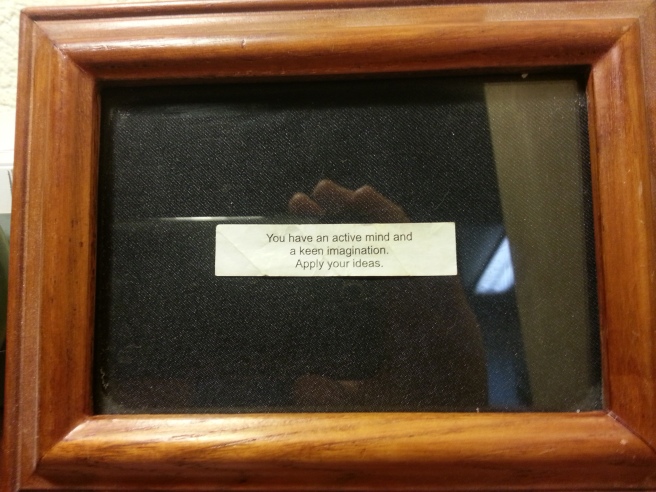
This is just a silly little thing I got from a fortune cookie a long time ago. I liked it enough to go to the thrift shop and get a little frame for it, and now it stands on my desk next to my Boba Fett pencil-holder mug and my little handwritten note reminding me that “its” is possessive and “it’s” is a contraction.
So, what’s your motivation? Do you have any silly little things laying around your house, reminding you to keep at it?
Short Story-Space Kitten

“What is it?” said Karen, staring at the blips on the radar screen.
“I don’t know,” Tom responded, the color draining from his face. “Some kind of deep-space radiation storm. But not like any I’ve ever seen.”
Boots, the new ship’s cat, jumped up onto the navigation console and strutted between Karen and the screen. She batted at the moving radar blips with her tiny paws. “Not now, Bootsie,” Karen scooped the cat up and deposited her on the ground. To Tom, she said, “Can we divert?”
Boots, insulted, sat and licked her paws.
“It’s too big and moving too fast. It’s coming right at us.” Tom read the displays for another second, scrolling through the data with one finger. Boots jumped back onto the console and rubbed her whiskers against Tom’s finger, closing her eyes and purring madly.
Tom shoved the cat out of his way. “Karen, I need to you go to the engine room and shut off all the manual breakers, so maybe this thing won’t fry our electronics. If it doesn’t kill us, at least we’ll have a functioning space ship.”
“I’m on it.” Karen rose up out of her seat and sprinted towards the cockpit door—and nearly tripped on the kitten that twined between her legs. She stumbled, stepping over the cat, and ran down the corridor.
The cat trotted behind her. “Meowp? Mroop? Mewp?”
Karen wrenched the breaker box open, ignoring the lid that clattered to the floor, making Boots jump. She frantically threw switches and pulled fuses out of their sockets. The fuses littered the floor of the engine room. One by one the ship’s systems shut down. The lights went out. The vent fans went quiet.
Boots batted a fuse down the corridor, then, after a butt-wiggling pause, chased after it.
One final breaker, and the artificial gravity shut off. Karen’s feet rose off the floor. Bootsie twisted around as she floated, still trying to get at the fuse.
“Here it comes!” Tom yelled down the corridor. “Hold on!”
The ship rocked violently. Green lightning shot across the engine room, showering sparks wherever it touched the metal bulkheads. There was a sound like the crackle of high-voltage wires. The overhead lights lit up of their own accord and pulsed a pale green. One of the lighting panels shattered and showered Karen with clear plastic shards.
Tiny green bolts of lightning shot from Karen’s fingers. Her teeth ached. She felt a rising warmth in her chest. The very air seemed to glow green. She screamed.
Boots howled.
In the cockpit, Tom hunched over, holding his belly, and gritted his teeth. his hair stood on end.
One more brilliant flash of green lightning, and it was over. The ship was quiet.
Karen replaced the fuse in the gravity system and sank gently to the floor as she eased the slider up to one g. She turned on a few more essential systems, then stumbled up to the cockpit while Boots, looking dazed, followed along behind her. “Are you okay?” she said to Tom.
“I think so,” he said, scrolling through the system diagnostics. “It’s crazy, but it seems like that storm…it seems like it didn’t do anything at all!”
Boots jumped up onto the console. The cat said, “You know, I’m actually not so sure about that.”
PSA: Matt Kincade is now on facebook and goodreads. Sort of.
With all the enthusiasm of a sullen teenager cleaning his room, I am expanding my online presence. Both of these profiles are skeletal at the moment, but maybe if you come say hi, I’ll have a reason to work on them a little more.
 Matt Kincade